


For years, the most reliable line in local government was some version of we’re not Washington. Congress could melt down and the White House could dominate every news cycle, but the city still plowed the streets, and residents gave it credit for that. New data from the Partnership for Public Service’s State of Public Trust 2026 report suggests that line is losing its power.
“We’re not Washington” has stopped working
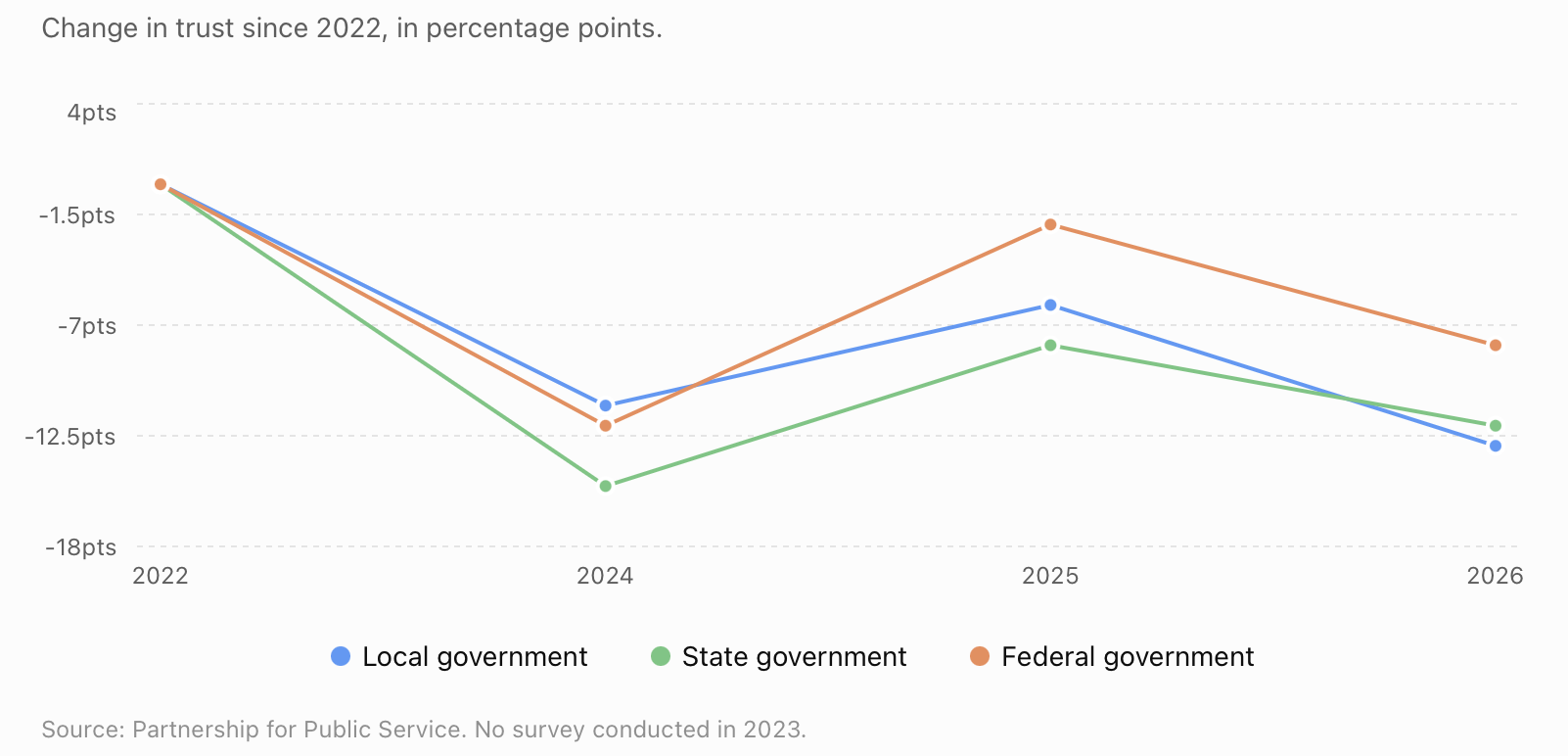
Trust in local and state government has fallen 12 to 13 points in four years, and it now rises and falls with Washington. That leaves less room for the service-first story cities have always told.
Four years, three levels of government, one direction
Percent who say they trust each level, 2022 versus 2026
The numbers, without the noise
The year-to-year swings in this survey are distracting, so ignore them. Compare 2022 to 2026 instead. Trust in local government fell from 54% to 41%, and trust in state government from 50% to 38%. Put plainly, about one in four people who trusted their city four years ago have stopped.
The lockstep problem
The drop isn’t even the most worrying part. It’s that local trust now moves in step with federal trust. Last year, federal fell six points, local seven, state four. Cities used to be graded on their own curve. Now, when Washington’s reputation sinks, city hall sinks with it, regardless of whether the buses ran on time.
The waste paradox
Here’s the strangest number in the report, and it says a lot about the reputation local governments are now inheriting.
How Americans describe the federal government
Percent who agree, 2026. The black mark shows an earlier reading.
After a year in which the federal government made cutting waste its loudest priority, the share of Americans calling it wasteful rose, from 61% to 75%. Nearly as many call it corrupt. You can’t cut your way to a reputation for competence, it seems, and local governments inherit whatever reputation “government” has.
An X marks the spot
Plot trust by party and the lines form an almost perfect X.
Trust in the federal government flips with the presidency
Percent who trust the federal government, by party. 2024 was Biden's last year; 2026 is Trump's second.
Republicans went from 10% to 42% trust in the federal government; Democrats went from 39% to 17%. Independents stayed stuck under 20% the whole time. Trust in government has stopped being a judgment about performance and become a statement about identity. That’s exactly the lens local leaders spent decades staying out from under.
Everyone else is having a terrible time
Now for the finding that should keep every city manager up at night, in a good way.
Good experiences build trust, but they stay private
Percent, 2026
The perception gap
Experience predicts trust
Nearly half of Americans say their own experiences with government have been mostly positive. But only 37% think most other people’s have been. We’ve collectively decided the DMV is miserable for everyone except ourselves. And experience matters enormously: people with good experiences are more than four times as likely to trust government as those with bad ones.
The people beat the institution
Meanwhile, views of public servants hit their highest point since the Partnership started asking.
People trust the workers more than the institution
Percent who agree, 2026. The black mark shows 2025.
Two-thirds of Americans now call civil servants competent. Americans are perfectly able to distrust “government” while respecting the people who work in it. That distinction is an opening.
Why a dashboard won’t fix this
The obvious prescription is transparency: publish the metrics, show the work. I built LA’s first Mayor’s Performance Dashboard, and I’ve also written about the limits of dashboards since. A chart of permit turnaround times doesn’t change how a resident feels. What changes it is the experience itself, and whether anyone hears about it.
The OECD research cited in the report backs this up: everyday service delivery drives trust in local government, while big-picture policy drives trust nationally. So the lever is in cities’ hands, but it’s not a data portal. It’s closing the loop when someone reports a pothole. It’s letting residents see the people who fixed it. It’s making one good experience visible enough that the neighbors stop assuming theirs would be bad.
One honest caveat
The 2026 survey had 1,000 respondents, a ±3.1 point margin, and was fielded during the Iran war and a partial shutdown, which likely pushed trust down across the board. Treat any single year with caution. The four-year slope, though, is hard to wish away.
“We’re not Washington” was never really a strategy. It was a gift from the public, and they’re taking it back. The cities that keep their residents’ trust will be the ones that earn it one visible interaction at a time.
Data: Partnership for Public Service and Impact Research, national surveys of U.S. adults, 2021 to 2026. The 2026 survey of 1,000 adults ran March 31 to April 5, with a margin of error of ±3.1 points. Read the full State of Public Trust in Government 2026 report.


